
Research · May 12, 2026
The Illusion of the Full Signal Bar: Why Connection Is Not Communication
Chapter One: Understanding the Restoration of Action-Critical Information in Imperfect Frontline Environments
Every operational leader has seen it: a device showing a full signal bar, yet a critical instruction never arrives, arrives too late, or arrives distorted. The full bar is read as a guarantee. It is not. It measures the strength of a radio connection to a tower — nothing about whether the message that matters actually reached the person who needed it, intact, in time, and in a form they could act on.
Connection is a physical state. Communication is an operational result.
This distinction is not semantic. It is the foundation on which Operational Communication, as a discipline, is built.
The Lifecycle of an Operational Directive
An operational instruction — "evacuate zone three," "hold the line," "confirm receipt" — does not travel as a single, indivisible thing. It passes through five distinct stages, and a failure at any one of them can produce the same outward symptom: a full signal bar and a message that never operationally arrived.
Information
The intent in a person's mind — what they need the receiver to know or do.
Data
That intent encoded into words, structured for transmission.
Signal
The data converted into a physical waveform carried across a network.
Imperfect Channel
The real environment the signal must survive — noise, distance, congestion, obstruction.
Restoration & Action
The receiver decodes the signal back into information and acts on it.
Each stage can degrade what came before it. A full signal bar only describes the health of the third stage. It says nothing about the fourth or the fifth — and it is the fourth and fifth stages where operations actually succeed or fail.
The Imperfect Channel: Why Full Bars Fail
Real operational environments are not laboratory conditions. The channel between sender and receiver is imperfect in ways a signal-strength indicator cannot capture:
- Acoustic noise — machinery, wind, crowds, protective equipment — can render a technically perfect transmission unintelligible to a human listener.
- Network latency — a message can be delivered a few seconds after it was needed, which in an operational context is the same as not being delivered at all.
- Jitter and packet loss — fragments of a voice message can be missing or reordered without any visible indicator to either party.
- Context preservation — a message stripped of who sent it, to whom, and why, arrives as noise even if every word is audible.
- Auditability — a message that cannot later be verified did not, in any operationally meaningful sense, leave a record that it occurred.
None of these failure modes move the signal bar. All of them break communication.
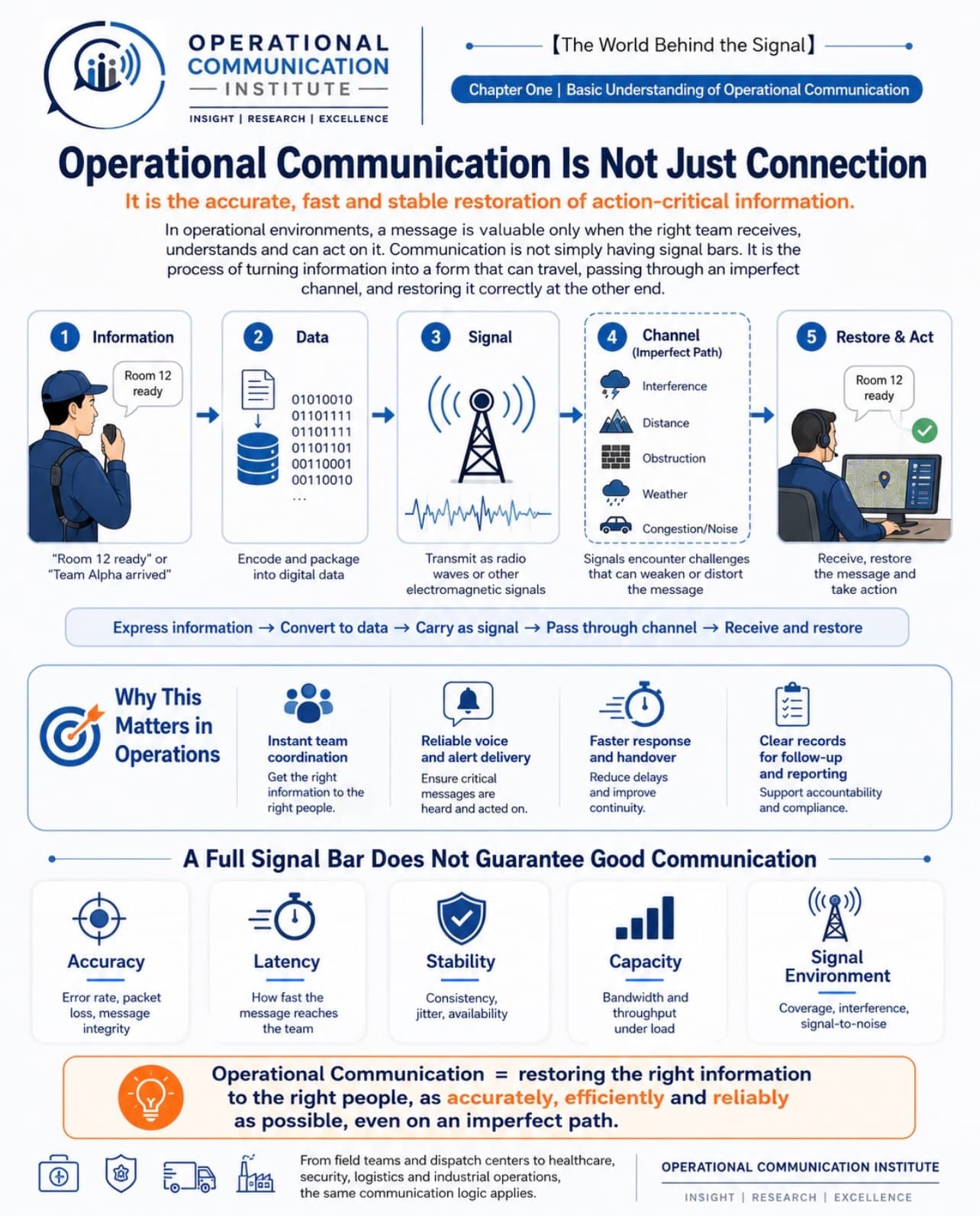
The 5 Dimensions of Operational Communication Health
If connection is not the right measure, what is? The Institute proposes five dimensions against which an operational communication environment should actually be evaluated.
Accuracy & Message Integrity
Technical Definition
Low error rate and zero packet loss.
Operational Reality
Does the complete instruction reach the receiver without corruption, loss of context, or misinterpretation?
Latency & Real-Time Responsiveness
Technical Definition
Sub-second end-to-end transmission delay.
Operational Reality
Can a worker initiate voice dispatch instantly, via dedicated push-to-talk, without waiting for app launches, dialing delays, or screen unlocks?
Stability & Background Persistence
Technical Definition
Low jitter and high availability.
Operational Reality
Does the communication channel remain actively connected in the background, even when devices are locked, screens are off, or heavy secondary applications are running?
Environmental & Hardware Resiliency
Technical Definition
Optimized signal-to-noise ratio (SNR) and specialized audio routing.
Operational Reality
Can the system operate hands-free using professional audio hardware — such as bone-conduction interfaces or noise-canceling headsets — in high-decibel or hazardous environments?
Semantic & Documentation Permanence
Technical Definition
Conversion of unstructured voice payload into structured data logs.
Operational Reality
Does the system automatically transcribe, timestamp, GPS-verify, and translate multi-language interactions into auditable operational records?
The Strategic Imperative: Auditing Your Operational Communication Stack
Most enterprise audits evaluate financial controls, cybersecurity protocols, and physical equipment maintenance. Yet almost no organization conducts a systematic Operational Communication Audit. These five dimensions translate into diagnostic questions every operational leader should be able to answer about their own frontline voice architecture:
- Are frontline workers relying on consumer messaging platforms and unrecorded phone calls for critical tasks?
- When an instruction is spoken over the air, does the system automatically document who spoke, when, and where?
- Can the communication layer operate seamlessly across different languages and high-noise environments?
- Is voice communication integrated into enterprise intelligence — or does it vanish the moment the conversation ends?
None of these are technology questions. They are questions about organizational discipline.
Fundamental Principle of the Institute
“
Operational Communication = Restoring the right information to the right people, as accurately, efficiently, and reliably as possible—even across an imperfect path.
”
Closing
The full signal bar will keep appearing on devices across every industrial site, hospital ward, warehouse and control room in the world. It will keep being read, informally, as reassurance. The work of Operational Communication as a discipline is to replace that informal reassurance with a measurable, governed standard — one that asks not "are we connected," but "did the right information reach the right person, intact, in time, and provably."
About the Operational Communication Institute
The Operational Communication Institute is an independent research body defining Operational Communication as a measurable business discipline. Its research, frameworks and assessment methodology are technology-neutral and are published to advance Operational Communication as a recognized organizational capability, not to promote any single vendor or platform.