
The Global Knowledge Hub for Operational Communication
Operational Communication
The Next Business Discipline.
Research • Frameworks • Standards • Assessment • Certification
What is Operational Communication?
Every operational activity begins with communication — a dispatcher coordinating an intervention, a supervisor assigning a task, a technician reporting a fault, a security officer requesting support, a warehouse operator confirming a shipment, a medical team escalating a critical situation. Communication is the first operational process; everything that follows depends on it.
Operational Communication is fundamentally different from everyday communication. Its purpose is to coordinate people, synchronize operational activities, and support real-time decision-making — where every second, instruction, and action can affect safety, continuity, and business performance.
It operates in real environments: construction sites, hospitals, factories, airports, ports, security operations, logistics centers, emergency response. Unclear communication rarely just causes misunderstanding — it can cause delayed interventions, operational disruption, financial loss, regulatory exposure, or risk to human safety. It must therefore be designed, measured, and continuously improved with the same discipline applied to cybersecurity, quality management, or business continuity.
Framework
Operational Communication Framework — Version 1.0
The foundational framework defining Operational Communication as a governed, measurable discipline.
Learn moreFree Screening
AIOperational Communication Health Check
A rapid, AI-assisted screening of your organization's operational communication environment.
Learn moreReference Model
Operational Communication Maturity Model
Five levels describing how communication capability develops from informal habit to governed discipline.
Learn moreOperational Communication Glossary
The reference terminology of Operational Communication, defined precisely and maintained by the Institute.
Industry Insights
Security
Healthcare
Logistics
Construction
Manufacturing
The Institute
An Independent Research Body
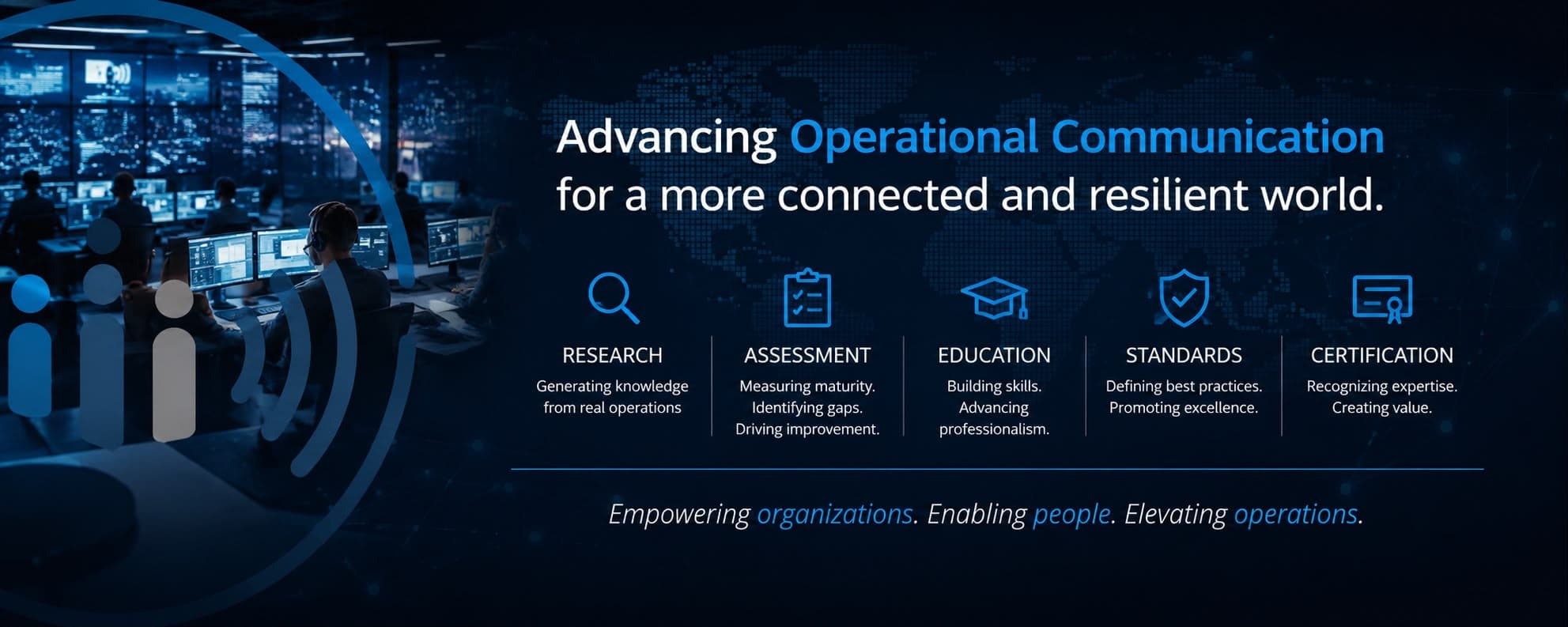
The Operational Communication Institute publishes research, frameworks and assessment methodology to establish Operational Communication as a recognized business discipline — independent of any single technology or vendor.
The Institute's research is technology-neutral. Learn about the Technology Partner.